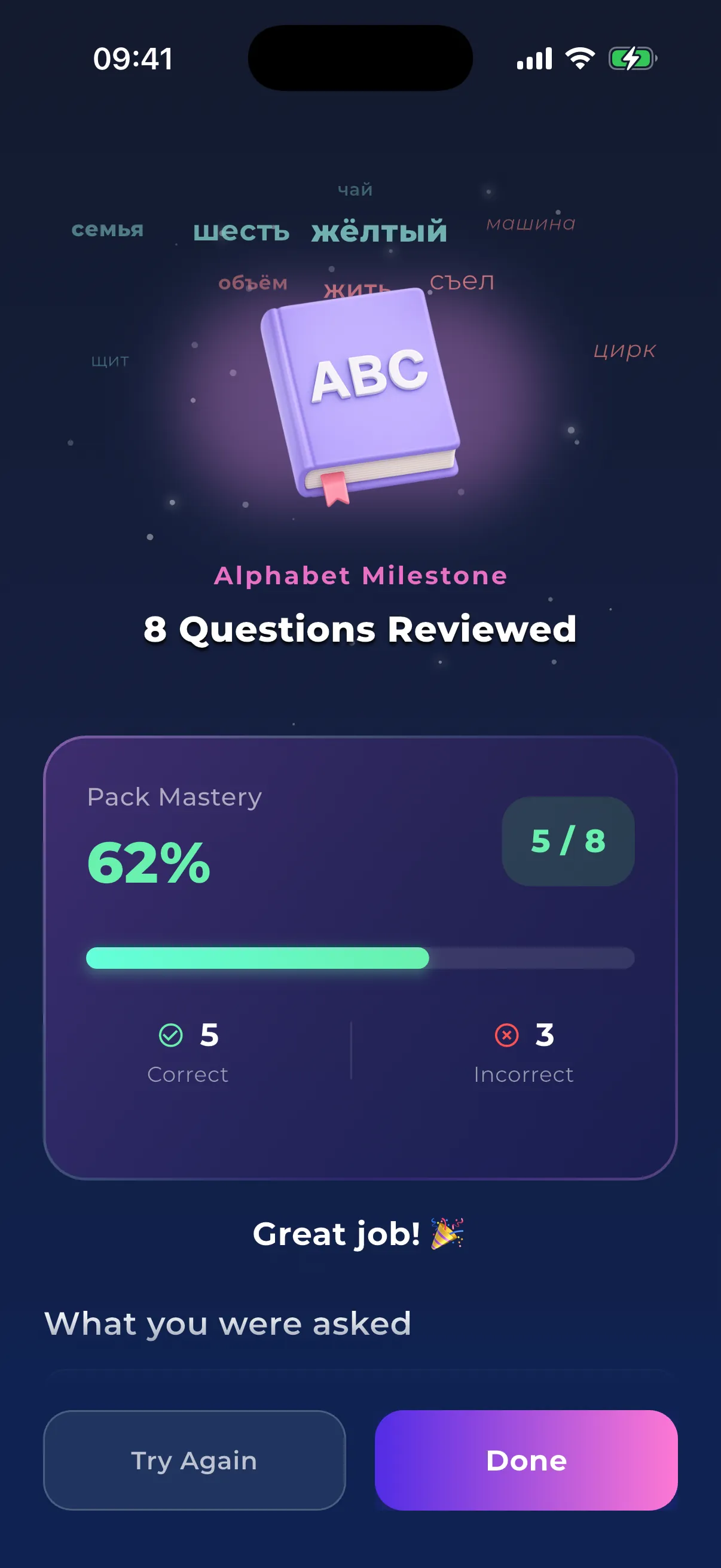
Most language apps assume you can already read the language. NativePal starts one step earlier. Alphabet lessons teach the letters and how they sound, a few at a time, with every sound explained in your own language, audio for each letter and real example words. A short quiz after each pack checks what stuck. It's how a complete beginner starts from zero, in any of the 57 languages.
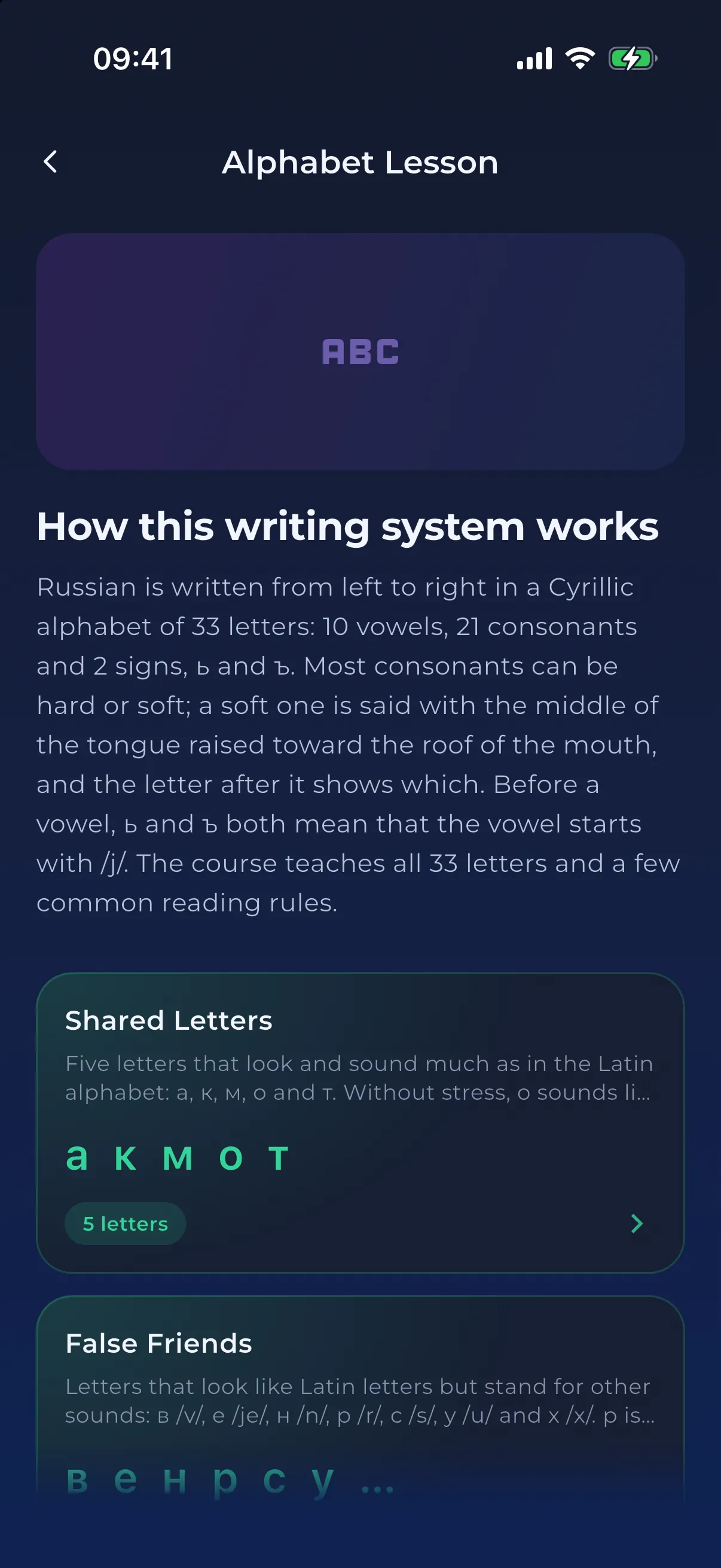
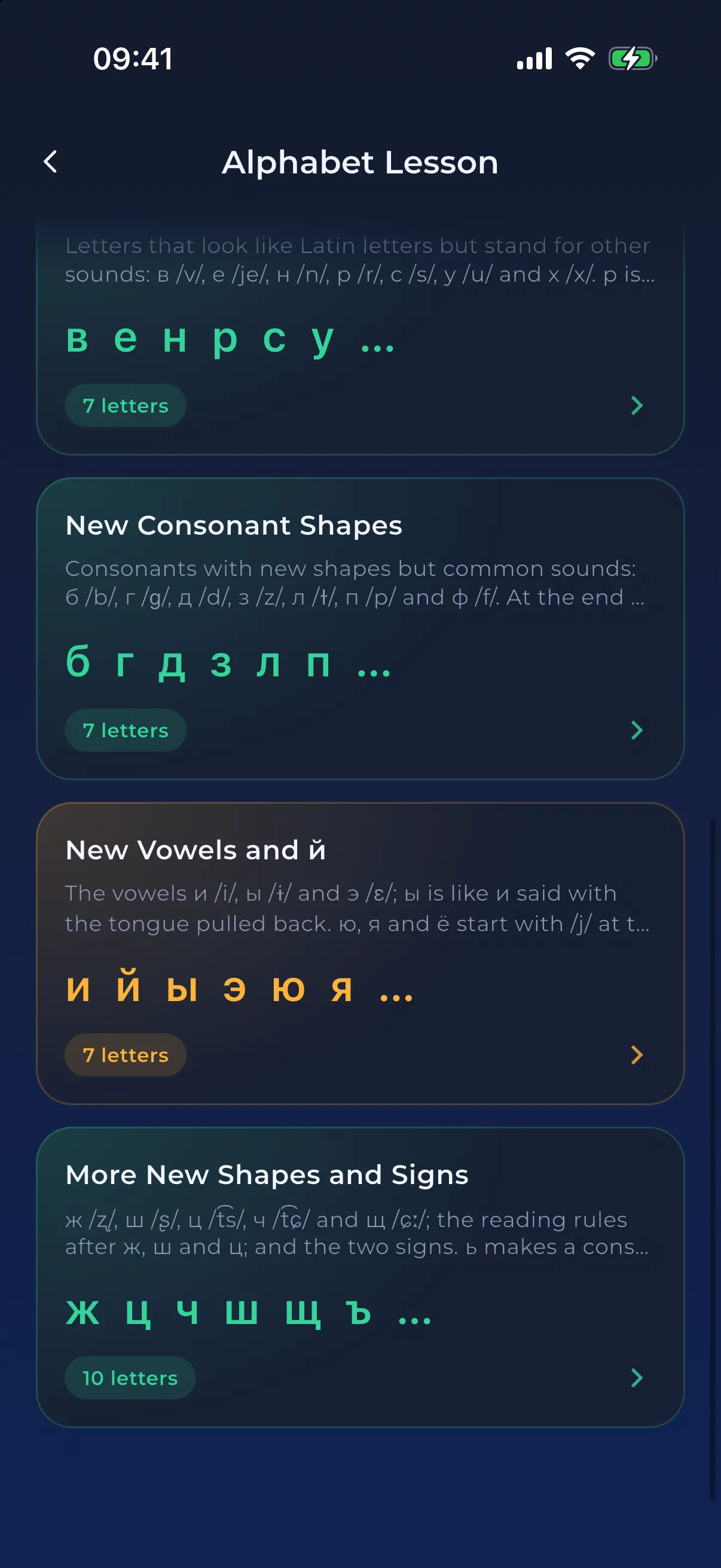
Every course opens with a short explanation of the writing system: which way it runs, how many letters it has, and what makes it different from what you know. If you read English, the Russian course starts with the five letters that already look familiar, then the false friends that look Latin but sound different, then the shapes that are new.
Letters come in small packs of four to twelve, in an order where each pack builds on the last. Latin-script courses teach how the letters sound in that language, plus the accents, letter groups and spelling rules that trip learners up: Spanish ñ and rr, the French nasal vowels, German ä, ö, ü and ß, Polish sz and cz. Finished packs are ticked off, so you always know where you are.
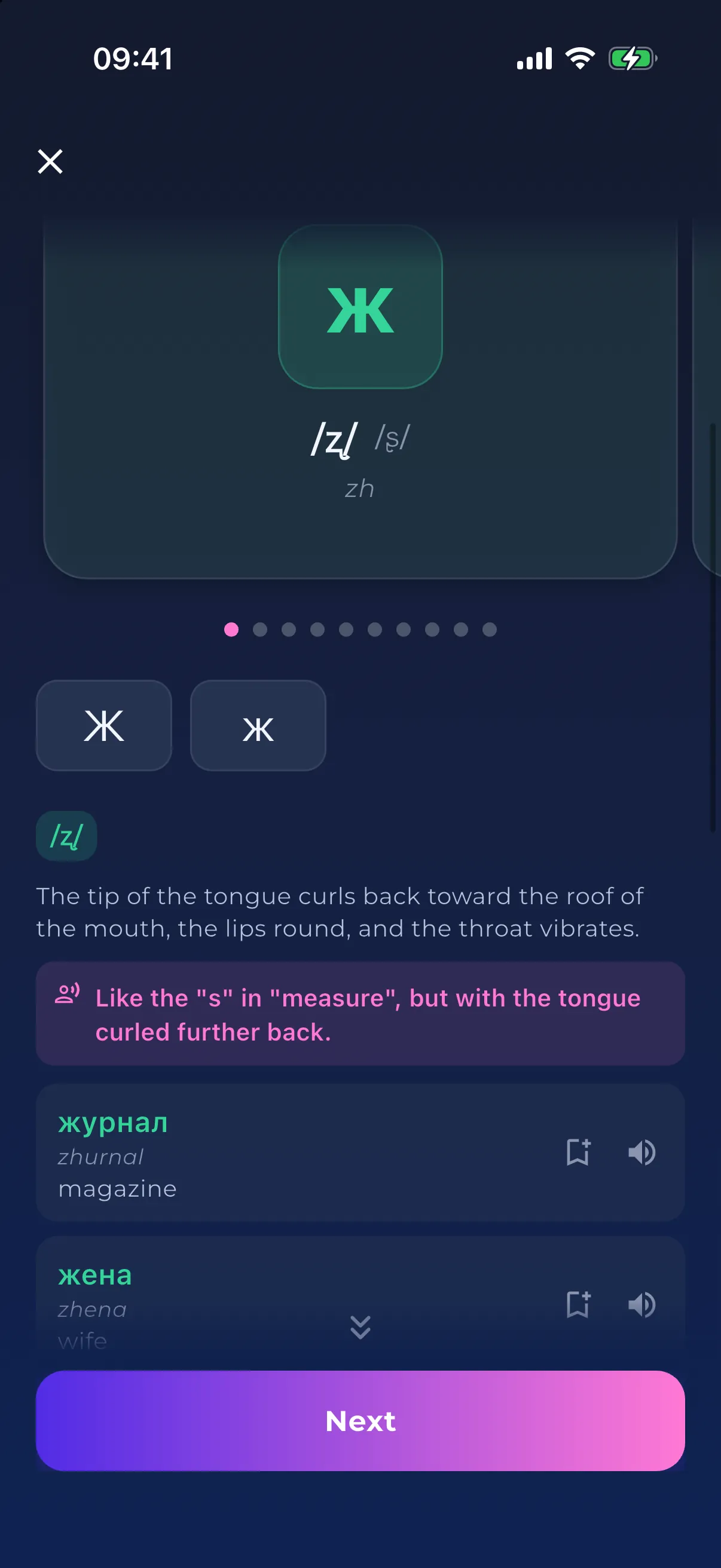
Each card shows the letter in its forms, the sounds it makes and when each one applies, written in your own language rather than in English. Where there is one, it names the nearest sound you already make, like the 's' in 'measure' for Russian ж. Tap to hear the letter, then see it at work in real words, each with its meaning, its spelling in Latin letters and its own audio.
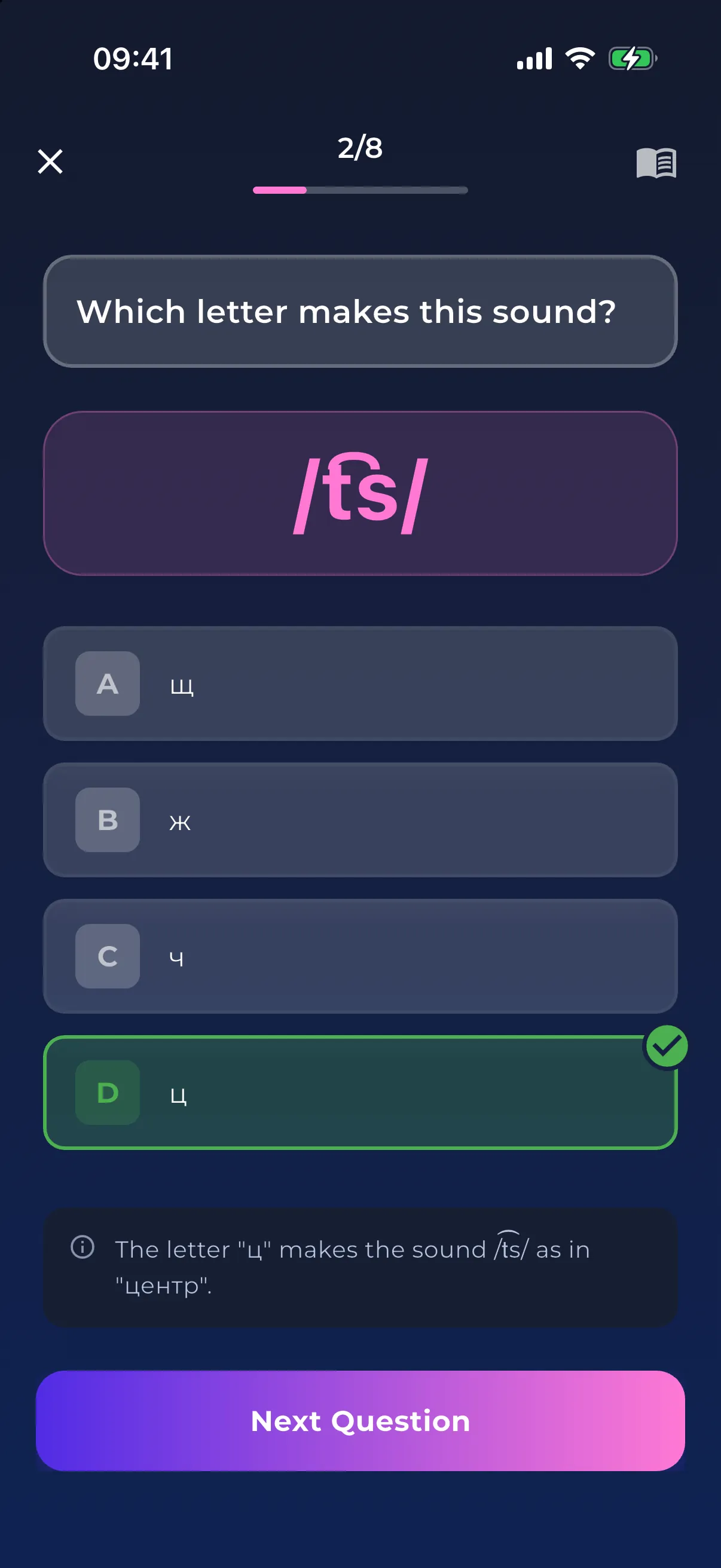
When you have read the cards, a short quiz checks what stuck: which letter makes a sound, how a letter sounds in a given position, its capital or joined form, or how it is written in Latin letters. Questions are in your own language, every answer comes with a one-line explanation, and the book icon brings the letters back if you need another look.
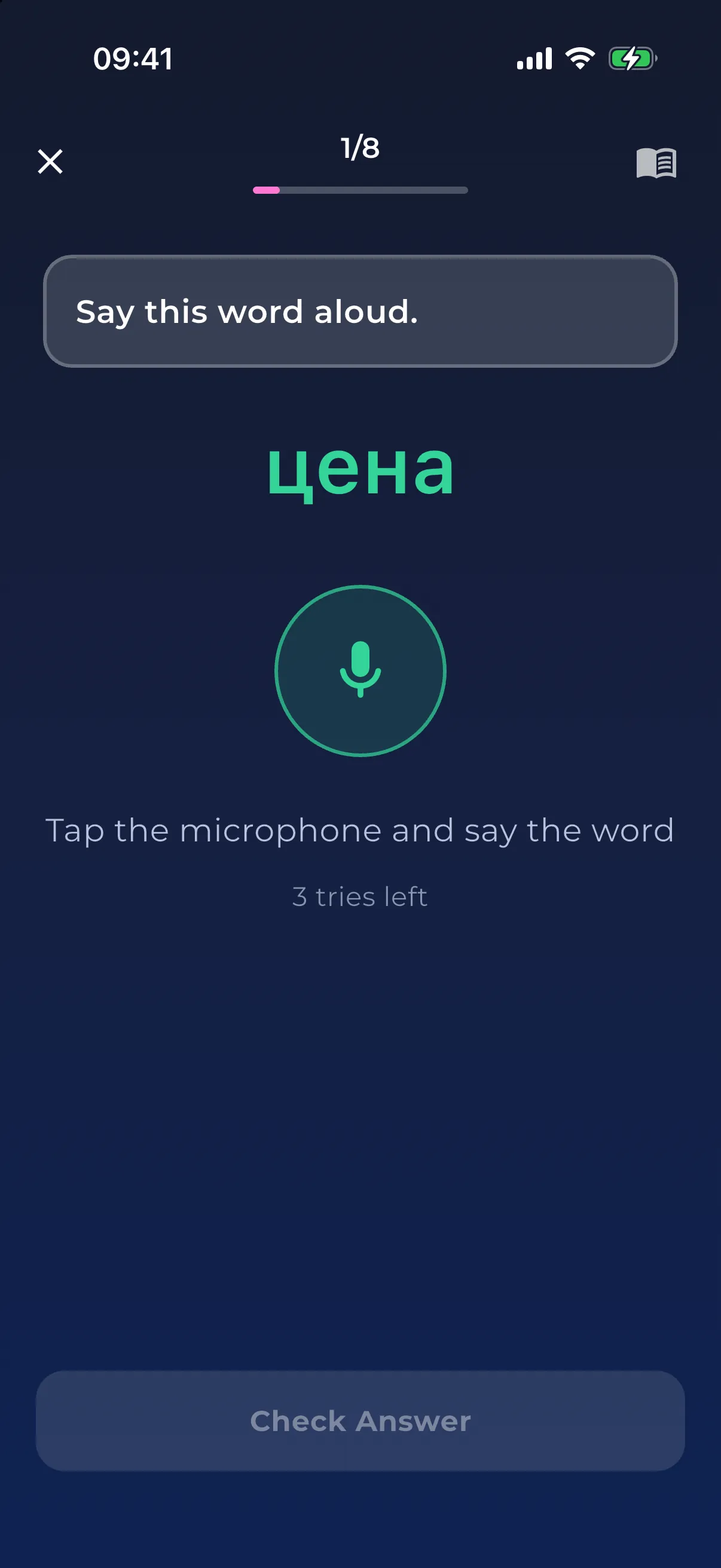
Some questions ask you to read a word aloud, and the app listens, with three tries per word. You can always move on if the moment isn't right. Prefer to stay quiet, or is your phone unable to recognise the language? Then the quiz sticks to tapping and typing.
Each quiz ends with your score for the pack and a review of every question you were asked, so you know which letters to look at again. Every finished quiz counts toward your streak and shows up in the Progress tab.
There is a course for every language NativePal teaches: Cyrillic for Russian, Ukrainian, Bulgarian, Serbian and others, Greek, Arabic and Urdu, Hebrew, Devanagari for Hindi, Marathi and Nepali, Bengali, Tamil, Telugu, Kannada, Thai, Korean Hangul, and the Latin alphabet for the rest. The Japanese course teaches hiragana and katakana, and the Chinese course teaches pinyin and its tones. Kanji and Chinese characters are not part of it: you meet them later, word by word, in reading lessons.
Every alphabet lesson is free, and you can reread any pack as often as you like. The free plan includes one alphabet quiz a day; premium removes the limit. Example words can be saved to your personal dictionary, and once the letters feel familiar, Learning Scenarios and A1 reading lessons take you from single words to your first sentences.
For learners who
Starting from zero: alphabet lessons for the letters and their sounds, guided beginner scenarios, A1 reading and five-word vocabulary, in your own language.
For learners who
Japanese, Korean, Arabic, Russian or Thai? Alphabet lessons teach a new script from zero, each sound explained in your own language, with audio and a quiz.
For learners who
The interface, explanations and feedback come in 57 languages, so a Vietnamese speaker learning Japanese is not routed through English. What that covers.
Yes. Alphabet lessons assume no prior knowledge. They teach the letters and how they sound a few at a time, with every sound explained in your own language, audio and real example words, then a short quiz. From there, Learning Scenarios and A1 reading lessons take you to your first words and sentences.
All 57 languages NativePal teaches. That includes Cyrillic (Russian, Ukrainian, Bulgarian, Serbian and others), Greek, Arabic, Urdu, Hebrew, Hindi and the other Devanagari languages, Bengali, Tamil, Telugu, Kannada, Thai, Korean Hangul, Japanese kana and Chinese pinyin. Latin-script courses cover how the letters sound in that language, with its accents, letter groups and spelling rules.
Not in alphabet lessons. The Japanese course teaches hiragana and katakana, and the Chinese course teaches pinyin and the four tones. Kanji and Chinese characters come later, word by word, in reading lessons, where every word can be tapped for a translation.
Only if English is your language. Each sound is explained in your own language, the one you chose for the app, which can be any of 57. Where there is one, the card also names the nearest sound you already make in that language.
After each pack, a short quiz asks about the letters you just read: which letter makes a sound, how a letter sounds in a given position, its other forms, how it is written in Latin letters, and, if you allow the microphone, saying a word out loud. Questions are in your own language, and every answer comes with an explanation.
Yes. Every alphabet lesson is free, and you can reread any pack as often as you like. The free plan includes one alphabet quiz a day; premium removes the limit.
Move on to Learning Scenarios, guided beginner chats on greetings, numbers and introducing yourself, and set reading lessons to A1 for very short stories with every word tappable. You don't need to finish every pack first: a pack a day alongside your first scenarios works well.
Explore More Features
Download NativePal and start practicing for free. Available in 57 languages on iOS and Android.
Alphabet lessons from zero • Levelled reading • Spaced-repetition vocabulary • Pronunciation feedback • 57 languages