
What's new in NativePal in October 2026
Alphabet lessons for all 57 languages: start from zero, with every letter and sound explained in your own language, audio, example words and a short quiz.
Alphabet lessons for all 57 languages: start from zero, with every letter and sound explained in your own language, audio, example words and a short quiz.
Until now NativePal assumed you could already read the language you were learning. Open Japanese, Korean or Arabic without knowing the script, and the app had nothing for your first week. Version 2.10 changes that. It adds alphabet lessons, so a complete beginner can start any of the 57 languages from zero.
Below is how they work, what is free, and what they do not cover.
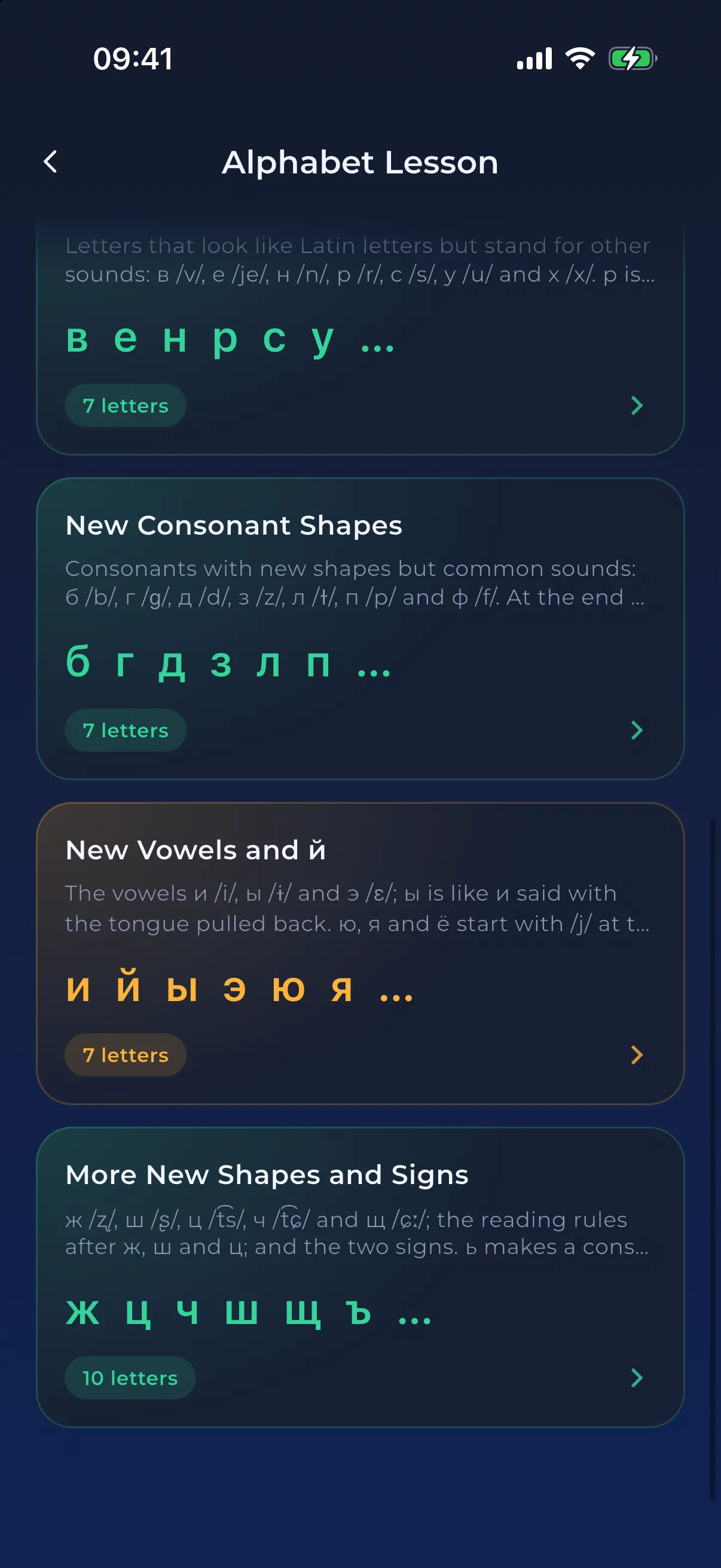
Each of the 57 languages has its own course. It opens with a short explanation of how the writing system works, then teaches the letters a few at a time, in packs of four to twelve. Cyrillic, Greek, Arabic, Hebrew, Devanagari, Bengali, Tamil, Telugu, Kannada, Thai and Korean Hangul all have one. So do the Latin-script languages, where the course covers how the letters sound in that language and the accents, letter groups and spelling rules that trip learners up.
We built it because the first week with a new script was the one part of learning a language the app did not cover.
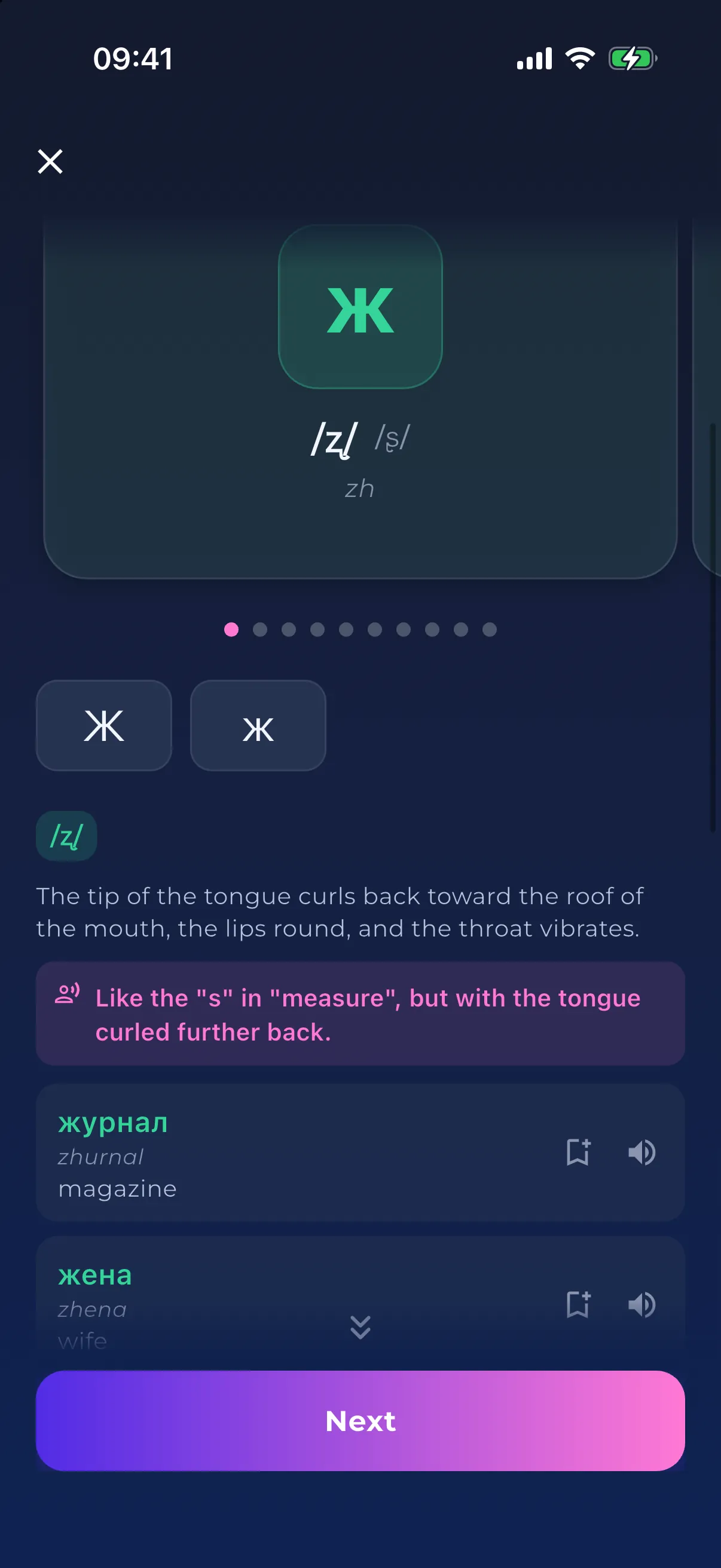
Each letter gets a card: its forms, the sounds it makes and when each one applies, written in your language rather than in English. Where there is one, the card names the nearest sound you already make, like the 's' in 'measure' for Russian ж. You can hear every letter and every example word, and save any example word to your dictionary.
That matters more than it sounds. A Spanish speaker and a Hindi speaker learning Russian start from different sounds, so each gets cards written for them.
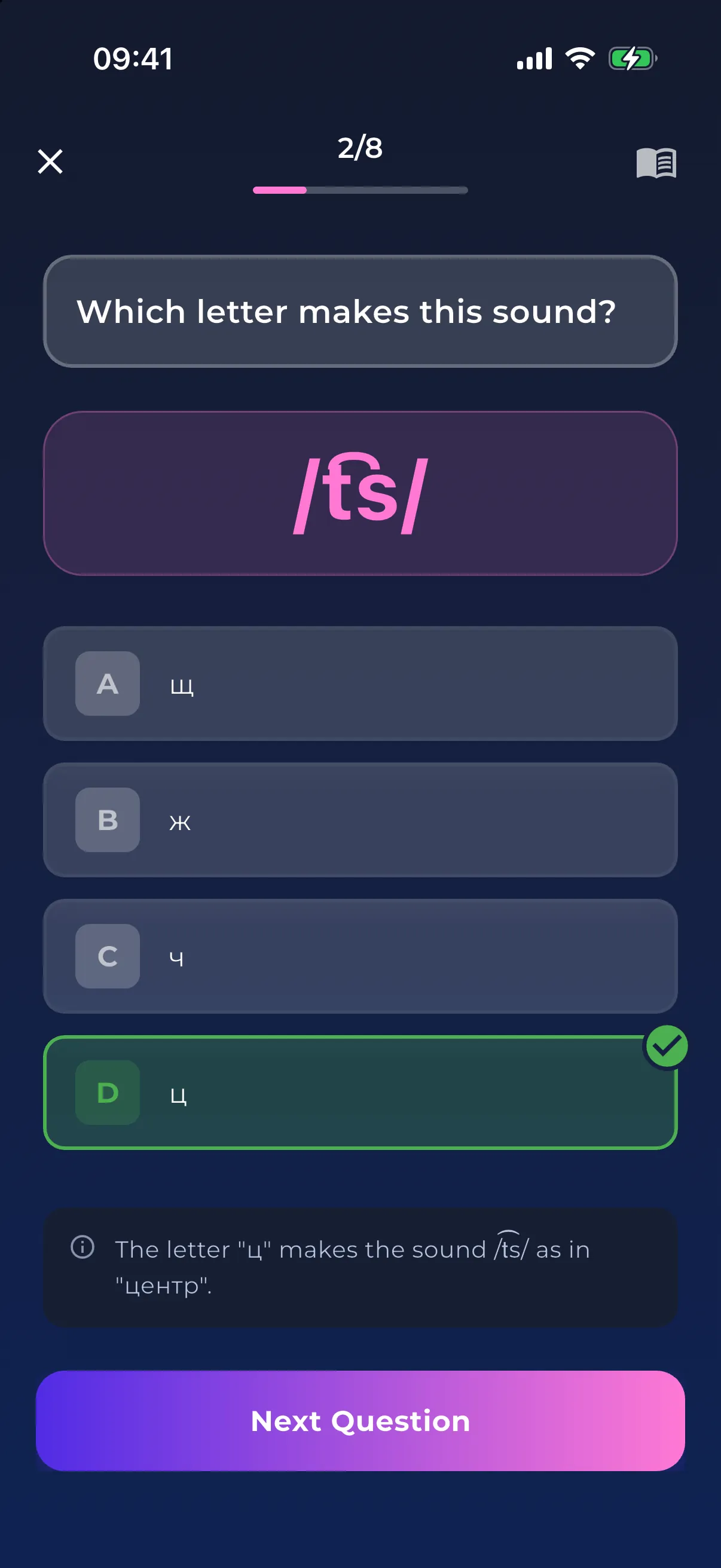
After each pack, a short quiz checks what stuck: which letter makes a sound, how a letter sounds in a given position, its other forms, how it is written in Latin letters. Some questions ask you to say a word out loud, and the app listens. If you would rather not use the microphone, the quiz sticks to tapping and typing.
Every finished quiz counts toward your streak.
Every alphabet lesson is free, and you can reread any pack as often as you like. The free plan includes one alphabet quiz a day; premium removes the limit.
Two limits worth knowing. The Japanese course teaches hiragana and katakana, and the Chinese course teaches pinyin and the four tones: kanji and Chinese characters are not part of them, and you meet those word by word in reading lessons. And the Serbian course teaches Cyrillic only, not the Latin alphabet Serbian also uses.
Yes. Since version 2.10 (October 2026), alphabet lessons teach the letters and their sounds from zero in all 57 languages, with every sound explained in your own language, audio, example words and a short quiz. Learning Scenarios and A1 reading lessons pick up from there.
Yes. The Japanese course teaches hiragana and katakana, and the Korean course teaches all 40 Hangul letters and how they stack into syllable blocks. Kanji are not part of the Japanese course.
Yes. Every alphabet lesson is free and can be reread as often as you like. The free plan includes one alphabet quiz a day; premium removes the limit.
Yes. Version 2.10 shipped in October 2026, after 2.9.1 in September. The release history on the What's new page lists every release back to the launch in February 2024.
Reading, vocabulary, scored speaking and conversation in 57 languages.


Free to start. No account needed.